Population
Popolazione
908
Lombardy | Province of Pavia
Lombardia | Provincia di Pavia
Bastida Pancarana is a small commune on the right bank of the Po: flat, exposed, quietly inhabited, and still defined less by monumentality than by parish life, civic spaces and ordinary ties with the wider Pavia–Voghera plain.
Bastida Pancarana è un comune piccolo sulla riva destra del Po: piatto, esposto, abitato senza enfasi, e ancora definito meno dalla monumentalità che dalla vita parrocchiale, dagli spazi civici e dai legami ordinari con la pianura tra Pavia e Voghera.
Its story is unusually legible for a place of this size: a fortified river point, a settlement repeatedly corrected by the Po, and a village that now lives behind embankments while keeping a recognisable civic core.
La sua storia è insolitamente leggibile per un luogo di questa scala: un punto fortificato sul fiume, un insediamento corretto più volte dal Po, e un paese che oggi vive dietro gli argini conservando però un nucleo civico riconoscibile.
Bastida Pancarana lies in the lower plain of the Oltrepò Pavese, about 14 kilometres south-west of Pavia. With just over nine hundred residents and a territory of 12.66 square kilometres, it is a very small municipality in demographic terms, but not an abstract one: the Po, the embankments and the history of flood damage still explain its position, form and mental geography.
Bastida Pancarana si trova nella pianura bassa dell’Oltrepò Pavese, a circa 14 chilometri a sud-ovest di Pavia. Con poco più di novecento residenti e un territorio di 12,66 chilometri quadrati, è un comune molto piccolo sul piano demografico, ma non astratto: il Po, gli argini e la storia dei danni da piena spiegano ancora oggi la sua posizione, la sua forma e la sua geografia mentale.
Bastida Pancarana sits at about 67 metres above sea level, in a completely flat landscape where the Po is not a scenic backdrop but a force that has repeatedly reorganised settlement. Even the place name points to embankments and flood defence, and local historical notes remember both an older fortified river role and the severe reduction of the village after eighteenth-century floods.
Bastida Pancarana si colloca a circa 67 metri di quota, in un paesaggio completamente piano dove il Po non è uno sfondo scenografico ma una forza che ha riorganizzato più volte l’insediamento. Anche il toponimo rimanda agli argini e alla difesa dalle piene, e le note storiche locali ricordano sia un più antico ruolo di punto fortificato sul fiume sia la drastica riduzione del paese dopo le alluvioni del Settecento.
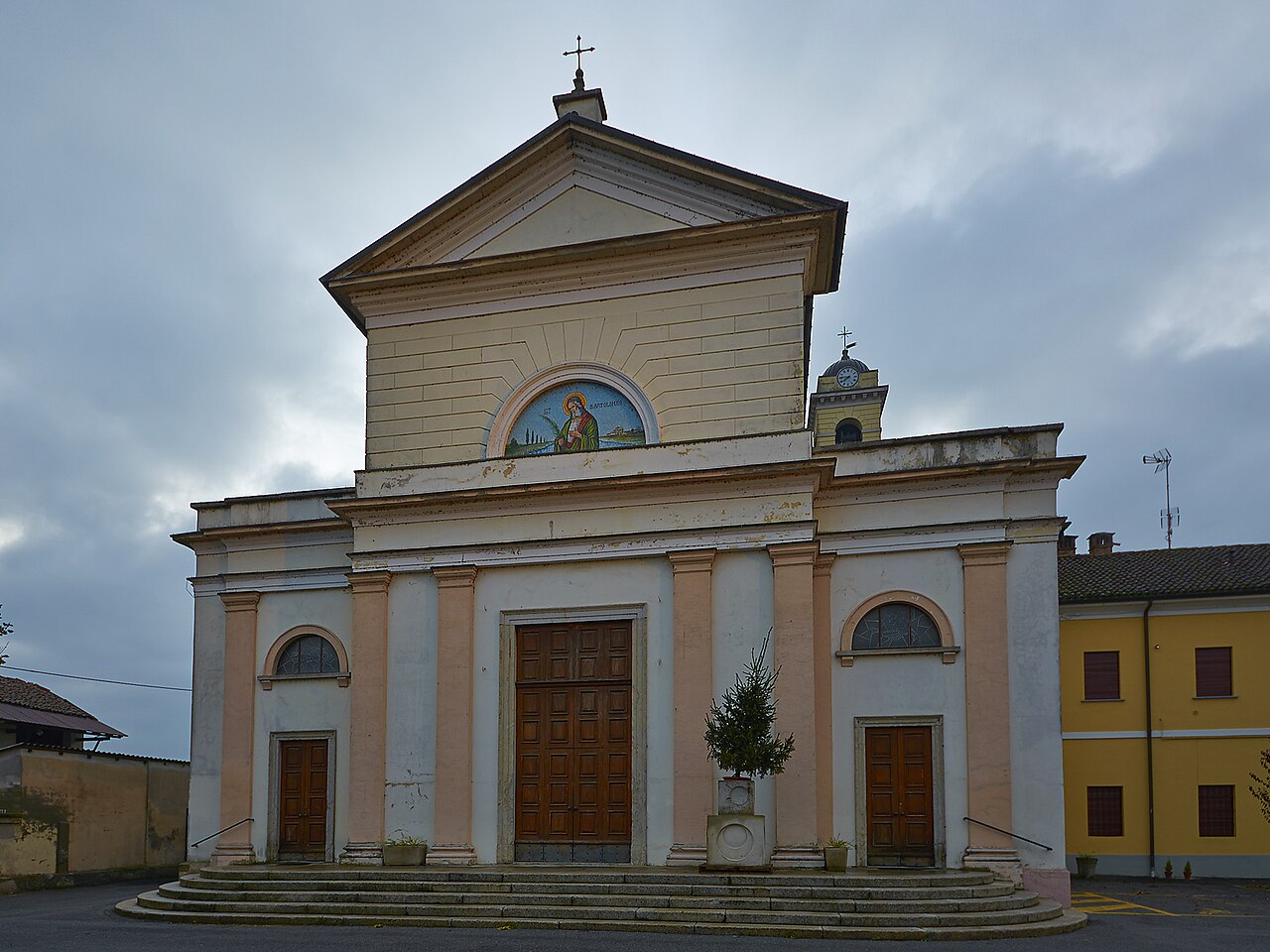
This matters because the commune is still read through distance from the river, protective earthworks and relocation toward safer ground. The former parish church at Isolino was destroyed by a Po flood in 1857, and the present church was rebuilt farther from the water between 1860 and 1862. In Bastida Pancarana, physical form and historical memory still overlap very directly.
Questo conta perché il comune si legge ancora attraverso la distanza dal fiume, le opere di difesa e lo spostamento verso suolo più sicuro. La precedente parrocchiale nella borgata Isolino fu distrutta da una piena del Po nel 1857, e l’attuale chiesa venne ricostruita più lontano dall’acqua tra il 1860 e il 1862. A Bastida Pancarana, forma fisica e memoria storica continuano a sovrapporsi in modo molto diretto.
The daily impression of Bastida Pancarana is one of compression rather than emptiness. It is a very small municipality, yet its village core still holds together municipal life, parish life, volunteering and a few shared cultural spaces.
L’impressione quotidiana di Bastida Pancarana è di compressione più che di vuoto. È un comune molto piccolo, eppure il suo nucleo di paese continua a tenere insieme vita municipale, vita parrocchiale, volontariato e alcuni spazi culturali condivisi.
Bastida Pancarana does not read as an open-ended plain settlement. The embanked condition gives it a more contained feel: houses, parish spaces and civic buildings gather into a modest village body rather than dissolving into a broad peri-rural field. The settlement seems to have learned caution from the river. That caution is spatial before it is rhetorical.
Bastida Pancarana non si legge come un insediamento di pianura aperto e indefinito. La condizione arginata gli dà un carattere più contenuto: case, spazi parrocchiali ed edifici civici si raccolgono in un corpo di paese modesto invece di dissolversi in un campo peri-rurale esteso. L’insediamento sembra aver imparato prudenza dal fiume. Ed è una prudenza prima spaziale che retorica.
For a commune below one thousand inhabitants, the civic network is still visible. The municipality highlights not only the town hall and the parish church, but also the Biblioteca A. Frank, the former SOMS hall and Auser volunteering. Recent public notices also show basic everyday functions still in use, from school transport to small cultural events. Broader needs depend on larger nearby centres, but Bastida Pancarana has not been reduced to pure residential residue.
Per un comune sotto i mille abitanti, la rete civica resta visibile. Il comune mette in evidenza non solo il municipio e la chiesa parrocchiale, ma anche la Biblioteca A. Frank, il salone ex SOMS e l’Auser. Anche gli avvisi recenti mostrano funzioni quotidiane ancora in uso, dallo scuolabus a piccoli eventi culturali. I bisogni più ampi dipendono dai centri vicini, ma Bastida Pancarana non si è ridotta a puro residuo residenziale.
Bastida Pancarana’s economy is small in absolute terms, so the point is not scale alone but measure. Here it is more useful to read how many firms are present, how thin the market is, and what that says about the commune’s dependence on the wider Pavia–Voghera plain.
L’economia di Bastida Pancarana è piccola in termini assoluti, quindi il punto non è solo la scala ma la misura. Qui è più utile leggere quante imprese siano presenti, quanto sia sottile il mercato e che cosa questo dica sulla dipendenza del comune dalla pianura più ampia tra Pavia e Voghera.
The numbers describe a commune with a narrow but real productive base. Sixty-seven firms for 908 residents do not make Bastida Pancarana a self-contained employment centre, yet they do show that the commune is more than a passive residential fragment. Within that small base, the visible profile is practical rather than specialised: agriculture, haulage, building-related work and other operational services recur more clearly than any advanced or corporate sector.
I numeri descrivono un comune con una base produttiva stretta ma reale. Sessantasette imprese per 908 residenti non fanno di Bastida Pancarana un centro occupazionale autosufficiente, ma mostrano comunque che il comune è qualcosa di più di un frammento residenziale passivo. Dentro questa base ridotta, il profilo visibile è pratico più che specializzato: ricorrono con maggiore evidenza agricoltura, autotrasporto, attività legate all’edilizia e altri servizi operativi, più che settori avanzati o strutture d’impresa complesse.
At €571 per square metre for sale and €8.01 per square metre for rent in March 2026, housing is materially accessible by provincial standards. But these figures should be read carefully: they also point to a limited and slow-moving market, where everyday viability depends heavily on connections to larger nearby centres for work, services and circulation.
Con €571 al metro quadrato in vendita e €8,01 al metro quadrato in affitto nel marzo 2026, la casa è materialmente accessibile rispetto agli standard provinciali. Ma questi numeri vanno letti con attenzione: indicano anche un mercato limitato e poco mosso, nel quale la praticabilità quotidiana dipende molto dai collegamenti con centri vicini più forti per lavoro, servizi e circolazione.
Bastida Pancarana’s identity does not come from abundance. It comes from a few elements that remain unusually legible: the Po, the rebuilt parish after flood destruction, and a civic life that survives in small but concrete places.
L’identità di Bastida Pancarana non nasce dall’abbondanza. Nasce da pochi elementi rimasti insolitamente leggibili: il Po, la parrocchia ricostruita dopo la distruzione della piena e una vita civica che sopravvive in luoghi piccoli ma concreti.
Bastida Pancarana is one of those small places where river history is not decorative. Historical summaries describe it as a fortified port and recall that the village once extended more broadly before repeated floods cut it back. The current settlement is therefore not simply old: it is what remained, what was moved, and what was defended.
Bastida Pancarana è uno di quei piccoli luoghi in cui la storia fluviale non è decorativa. Le sintesi storiche lo descrivono come porto fortificato e ricordano che il paese un tempo si estendeva più ampiamente prima che le piene ripetute lo riducessero. L’insediamento attuale quindi non è semplicemente antico: è ciò che è rimasto, ciò che è stato spostato e ciò che è stato difeso.
Even today the municipality’s own emergency documentation speaks of hydraulic risk, embankment works and altered side channels of the Po. In other words, the river is still a living condition of the place.
Ancora oggi la documentazione comunale di protezione civile parla di rischio idraulico, opere di arginatura e rami secondari del Po modificati. In altre parole, il fiume resta una condizione viva del luogo.
The parish church of San Bartolomeo matters not only as a religious building, but as a material reminder of relocation after the 1857 flood. Around it, the municipal map of places remains tellingly modest but complete in the right way: town hall, public library, ex SOMS hall, Auser volunteering and parish space.
La chiesa parrocchiale di San Bartolomeo conta non solo come edificio religioso, ma come promemoria materiale dello spostamento seguito alla piena del 1857. Attorno ad essa, la mappa comunale dei luoghi resta modestamente ma giustamente completa: municipio, biblioteca pubblica, salone ex SOMS, Auser e spazio parrocchiale.
For an unprepared reader, two of these references need clarification. An ex SOMS hall is the former hall of a Società Operaia di Mutuo Soccorso: one of the mutual-aid societies that, in many Italian towns, historically offered workers a place for solidarity, meetings and local social life. Auser, by contrast, is a contemporary volunteer association active across Italy, often linked to everyday support, social companionship and community initiatives, especially for older residents. In Bastida Pancarana, these names matter because they show that civic life is not only housed in formal institutions, but also in inherited associative spaces and practical local volunteering.
Per un lettore non abituato a questi riferimenti, due nomi chiedono una spiegazione. Il salone ex SOMS è l’ex sede o sala di una Società Operaia di Mutuo Soccorso: una di quelle associazioni nate in molti centri italiani per offrire ai lavoratori aiuto reciproco, occasioni di incontro e vita sociale locale. Auser, invece, è un’associazione di volontariato attiva in tutta Italia, spesso legata al supporto quotidiano, alla socialità e a iniziative di comunità, soprattutto per la popolazione più anziana. A Bastida Pancarana questi riferimenti contano perché mostrano che la vita civica non passa solo attraverso le istituzioni formali, ma anche attraverso spazi associativi ereditati e forme pratiche di volontariato locale.
Like many very small communes in the Po plain, Bastida Pancarana stands between endurance and thinning out. Some of its strengths are structural; some of its limits are structural too.
Come molti comuni molto piccoli della pianura del Po, Bastida Pancarana sta tra resistenza e assottigliamento. Alcune sue forze sono strutturali; strutturali sono anche alcuni limiti.
The river setting, the embanked landscape, the rebuilt parish core and the small network of municipal and associative places still give Bastida Pancarana a readable structure. It remains possible to understand what the commune is, how it formed, and where daily life is anchored.
L’impianto fluviale, il paesaggio arginato, il nucleo parrocchiale ricostruito e la piccola rete di luoghi municipali e associativi continuano a dare a Bastida Pancarana una struttura leggibile. È ancora possibile capire che cos’è il comune, come si è formato e dove si ancora la vita quotidiana.
With fewer than one thousand residents, a thin housing market and strong dependence on external centres, Bastida Pancarana cannot easily absorb the loss of services, associations or connections. Hydraulic exposure is part of its long history, but so is demographic and functional fragility. The challenge is not to invent a grand future, but to keep ordinary viability in place.
Con meno di mille residenti, un mercato abitativo sottile e una forte dipendenza dai centri esterni, Bastida Pancarana non può assorbire facilmente la perdita di servizi, associazioni o collegamenti. L’esposizione idraulica fa parte della sua lunga storia, ma anche la fragilità demografica e funzionale. La sfida non è inventare un grande futuro, bensì mantenere in sede la praticabilità ordinaria.